![[personal profile]](https://www.dreamwidth.org/img/silk/identity/user.png)
Hawaiian is the native Polynesian language of the Hawaii archipelago, now critically endangered (around 300 people speak it as their primary language, and roughly 23,000 as a second language). Which is a shame as it a) sounds beautiful and b) has given English many words that aren’t aloha. Enough, in fact, for two weeks of well-known words other than aloha. [Sidebar: Yes, it’s a stretch to make this part of this series of words from native American languages, given Hawaii is not actually in the Americas—but it is in the Western Hemisphere and core territory of a major American country, so I’m going for it.] And first up is:
ukulele (yoo-kuh-LAY-lee, oo-koo-LAY-lay) - n., a small four-stringed guitar popularized in Hawaii.
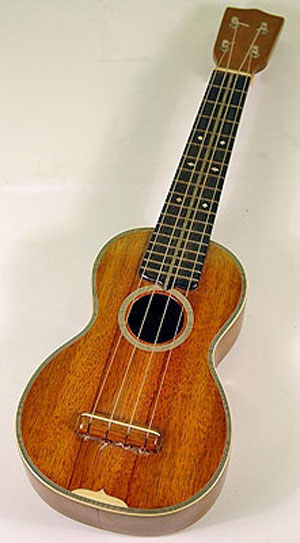
Thanks, WikiMedia!
Descended from the very similar machete/cavaquinho played in the Portuguese islands of Madeira, the Azores, and Cape Verde, brought to Hawaii in the mid-1800s by Madeiran sailors and adapted to local materials. It was popularized in the 1910s in exhibitions and became a staple instrument of the Jazz Age, until finally supplanted by the guitar as something easily portable in the 1950s. I play a tenor size uke myself. The name is from Hawaiian ʿukulele, lit. leaping flea, from ʿuku, flea + lele, to jump/leap, and while there are several stories that attempt to explain this, none have solid evidence, and they mostly boil down to the rapid movement of fingers over the strings. 🤷🏼
---L.
ukulele (yoo-kuh-LAY-lee, oo-koo-LAY-lay) - n., a small four-stringed guitar popularized in Hawaii.
Thanks, WikiMedia!
Descended from the very similar machete/cavaquinho played in the Portuguese islands of Madeira, the Azores, and Cape Verde, brought to Hawaii in the mid-1800s by Madeiran sailors and adapted to local materials. It was popularized in the 1910s in exhibitions and became a staple instrument of the Jazz Age, until finally supplanted by the guitar as something easily portable in the 1950s. I play a tenor size uke myself. The name is from Hawaiian ʿukulele, lit. leaping flea, from ʿuku, flea + lele, to jump/leap, and while there are several stories that attempt to explain this, none have solid evidence, and they mostly boil down to the rapid movement of fingers over the strings. 🤷🏼
---L.

