![[personal profile]](https://www.dreamwidth.org/img/silk/identity/user.png) prettygoodword
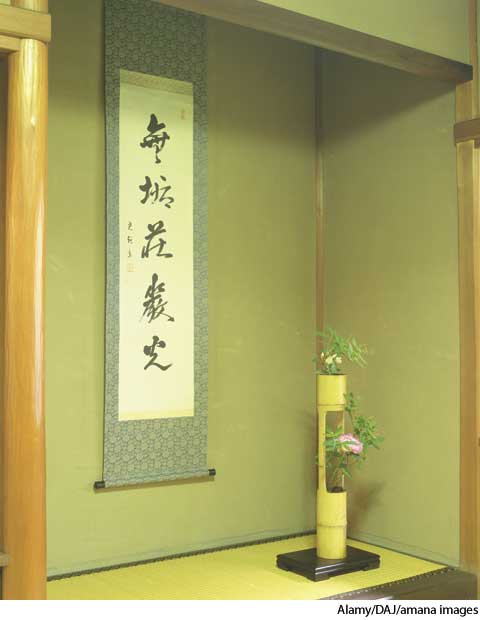
prettygoodwordkakemono (kah-kuh-MOH-noh) - n., a Japanese hanging scroll with calligraphy or a painting.
Displayed vertically on the wall, or rolled up when not in use. This is the Japanese version of the Chinese lìzhóu. Adapted from Japanese, naturally, where it's also kakemono (掛物), compounded from the stem of kakeru, to hang + mono, thing -- so literally, hanging thing.
---L.
Displayed vertically on the wall, or rolled up when not in use. This is the Japanese version of the Chinese lìzhóu. Adapted from Japanese, naturally, where it's also kakemono (掛物), compounded from the stem of kakeru, to hang + mono, thing -- so literally, hanging thing.
---L.


![[identity profile]](https://www.dreamwidth.org/img/silk/identity/openid.png)
no subject
Date: 2016-09-28 03:23 am (UTC)no subject
Date: 2016-09-28 02:35 pm (UTC)no subject
Date: 2016-09-28 02:36 pm (UTC)And to clarify, those are the (two alternate) Chinese hanzhi for the thing.
no subject
Date: 2016-09-29 06:23 am (UTC)no subject
Date: 2016-09-30 04:51 am (UTC)Wiktionary (my first port of call in such cases) doesn't know any of the three. Naver acknowledges only 立軸, and then only to point to Yahoo! Japan, I think. ¯\_(ツ)_/¯ For Korean, it seems, the individual characters in those three terms are comprehensible, but not any of the pairwise combinations. (That's common, AFAIK in my relative ignorance; my mother was able to figure out my query about 真逆 after discussing it with a friend who speaks Mandarin, but among CJK (dunno about Viet), it's valid semantically only in Japanese.)
no subject
Date: 2016-09-30 02:33 pm (UTC)