![[personal profile]](https://www.dreamwidth.org/img/silk/identity/user.png) prettygoodword
prettygoodwordA week of miscellaneous words from Nahuatl [along with a sidebar reminder that the -tl suffix in Nahuatl sounds a lot softer than it looks, closer to -tsch than -tuhl] starting with:
coyote (kai-OH-tee, KAI-oht) - n., a wolflike carnivorous canid (Canis latrans) of North America, with buff-gray to reddish-gray fur, large erect ears, and a drooping bushy tail.
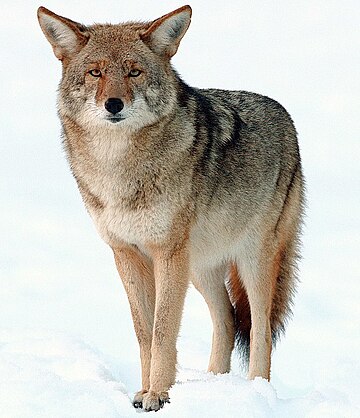
Thanks, WikiMedia!
Also called prairie wolf and American jackal -- the former because it resembles a smaller, gracile wolf, the latter because it fills much the same ecological niche that jackals do in Eurasia. Coyotes have adapted very well to urban environments, to the point that their range has been expanding over the last century as humans have extended their range -- we can hear coyote choruses of yips and howls several nights a year, and meet them in alleys at dawn. [Sidebar: our cats are indoor cats yes indeedy.] Before migrants to the American Southwest came to dominate the population here, the pronunciation used to be a shibboleth: only imports called them kai-OH-tee, while locals used KAI-oht. Taken in the 1750s from Mexican Spanish (where it always has three syllables), from Nahuatl coyōtl.
---L.
coyote (kai-OH-tee, KAI-oht) - n., a wolflike carnivorous canid (Canis latrans) of North America, with buff-gray to reddish-gray fur, large erect ears, and a drooping bushy tail.
Thanks, WikiMedia!
Also called prairie wolf and American jackal -- the former because it resembles a smaller, gracile wolf, the latter because it fills much the same ecological niche that jackals do in Eurasia. Coyotes have adapted very well to urban environments, to the point that their range has been expanding over the last century as humans have extended their range -- we can hear coyote choruses of yips and howls several nights a year, and meet them in alleys at dawn. [Sidebar: our cats are indoor cats yes indeedy.] Before migrants to the American Southwest came to dominate the population here, the pronunciation used to be a shibboleth: only imports called them kai-OH-tee, while locals used KAI-oht. Taken in the 1750s from Mexican Spanish (where it always has three syllables), from Nahuatl coyōtl.
---L.


no subject
Date: 2025-09-08 09:02 pm (UTC)no subject
Date: 2025-09-09 02:51 pm (UTC)no subject
Date: 2025-09-08 10:54 pm (UTC)(Also, almost no North American rabbits (or hares, including jackrabbits) burrow.)
no subject
Date: 2025-09-09 02:50 pm (UTC)